
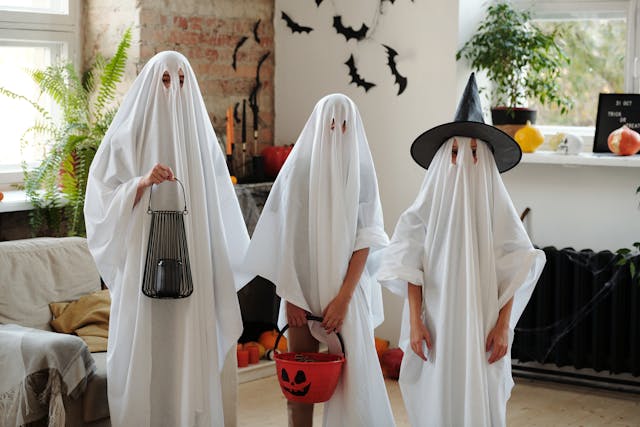
Witches and ghosts are two of the most iconic Halloween icons. Would you believe you can make a case for both of them in the bible? Let’s start with witches.
Leviticus 19:31
Do not turn to mediums or necromancers; do not seek them out, and so make yourselves unclean by them: I am the Lord your God.
Leviticus 20:27
“A man or a woman who is a medium or a necromancer shall surely be put to death. They shall be stoned with stones; their blood shall be upon them.”
That translation (NIV) doesn’t specifically mention the word “witch.” It does use the word “medium.” And there are differences. If you were to to make a list of all the things witches can do, according to popular culture, you might come up with something like this:
Casting of spells
Riding brooms
Female
Green skin?
When we talk about mediums in the bible, though, scholars define the term by one ability. The ability to talk to the dead, or at least the claim to be able to do so. Why would the Mosaic law tell the people not to associate with mediums? It may have to do with soothsaying. People who wanted to talk to mediums usually wanted to ask them questions about what to do with their lives. This practice takes the people’s focus off of God for guidance and onto something else. Saul had gotten rid of mediums in accordance with this law, so it is especially interesting to see the events unfold in 1 Samuel:
1 Samuel 28:3-15
3 Now Samuel was dead, and all Israel had mourned for him and buried him in his own town of Ramah. Saul had expelled the mediums and spiritists from the land.
4 The Philistines assembled and came and set up camp at Shunem, while Saul gathered all Israel and set up camp at Gilboa. 5 When Saul saw the Philistine army, he was afraid; terror filled his heart. 6 He inquired of the Lord, but the Lord did not answer him by dreams or Urim or prophets. 7 Saul then said to his attendants, “Find me a woman who is a medium, so I may go and inquire of her.”
“There is one in Endor,” they said.
8 So Saul disguised himself, putting on other clothes, and at night he and two men went to the woman. “Consult a spirit for me,” he said, “and bring up for me the one I name.”
9 But the woman said to him, “Surely you know what Saul has done. He has cut off the mediums and spiritists from the land. Why have you set a trap for my life to bring about my death?”
10 Saul swore to her by the Lord, “As surely as the Lord lives, you will not be punished for this.”
11 Then the woman asked, “Whom shall I bring up for you?”
“Bring up Samuel,” he said.
12 When the woman saw Samuel, she cried out at the top of her voice and said to Saul, “Why have you deceived me? You are Saul!”
13 The king said to her, “Don’t be afraid. What do you see?”
The woman said, “I see a ghostly figure[a] coming up out of the earth.”
14 “What does he look like?” he asked.
“An old man wearing a robe is coming up,” she said.
Then Saul knew it was Samuel, and he bowed down and prostrated himself with his face to the ground.
15 Samuel said to Saul, “Why have you disturbed me by bringing me up?”
This is a biblical ghost story. It has a medium speaking to the dead, and the “ghost” of Samuel in it. The term “ghost” used to have meaning only as it applied to breath. The word was originally “gast.” The “h” was later added due to the influence of the Flemish. It is hard to make the “h” sound without breathing out, so people literally added breath to the word. Later the “a” was changed to “o” and we arrived at the word “ghost.”
Older bible translations will refer to the Holy Spirit as the Holy Ghost. In this case ghost and spirit are synonymous. The pagan concept of ghost dates back pretty much as far as civilization, defined as spirits of the dead. Throughout history there seems to be some combination of three things that might cause someone who died to become a ghost. You became a ghost if:
You were not buried properly
You had a big reason to remain on earth
You were somehow prevented from going to the afterlife.
We owe our observance of Halloween in the US to the Irish potato famine. The lack of food caused many Irish to immigrate to the new world, and they brought with them their holiday called Samhain. It was celebrated as an end-of-October harvest festival, but it was also thought that this day was the day when the veil between the living and the dead was the thinnest. In other words, spirits from the dead could cross over and come back to earth.
The whole idea of ghosts center around the thought that the dead don’t belong here. Being on earth means you are in the land of the living, and not being here means you are alive no longer. You are either here or you are there. And this is how we have defined death throughout the ages. If your body isn’t working on earth (or doesn’t exist anymore) you are dead. If it is you are alive.
But then came Jesus. He defined life in a new way. Christianity says that life isn’t defined be whether or not you have a pulse. Life is your spiritual relationship with God. Christ promises everlasting life—your relationship with God remains after your time on earth. It is important to note the resurrection of Jesus was not told as a ghost story. The believers did not simply see a spirit of Jesus after Easter. They saw a full-bodied man. This was necessary because otherwise the story is of that of Jesus’ ghost. He wasn’t buried properly. He had a big reason to remain. The bible goes out of its way to tell us that Jesus was and is alive, and his death on the cross had nothing to do with his (everlasting) life.
The only ghost story your life will be is the ghost story of you receiving the breath of God, and therefore life in abundance.