
Homecoming is happening in colleges and high schools across the country. I remember what a spectacle it was for me when I was in college. The school built a huge bonfire in the middle of campus days ahead of time. It was a behemoth of wood, and every time we walked past it we were reminded of what was coming. The Friday night of that week it was lit and was quite a sight.
Have you ever wondered how we started this tradition? Why do we light bonfires? I found this on the Dartmouth University website, explaining why this began on their campus:
The first bonfire was lit 136 years ago to celebrate a victorious baseball game against a team from Manchester, N.H., according to documents from the Rauner Special Collections Library. The night of the celebration, students — freshmen and upperclassmen alike — scoured the town for combustible material. In their pursuit of something to burn, the students “disturbed the slumbers of a peaceful town, destroyed some property, made the boys feel that they were men and in fact did no one any good,” The Dartmouth reported in 1979.
So there you have it. Boys wanted something to burn to celebrate a sports victory.
That is not the origin of the bonfire though. People have been building them a lot longer than that. It used to be thought that the term “bonfire” meant “good fire.” This makes some sense because “bon” in French means good. But the real meaning of the word is more sinister.
Bonfire used to mean a fire of bones. That is a lot scarier concept than something you would do to celebrate a school’s homecoming. But why would you burn bones? There were two main reasons: funerals and executions. It was later that the act morphed into a celebration. They were applied to the burning of yard trash or unwanted possessions. Eventually bonfires were tied to the worship services centered around remembrance of saints. Bonfires became a cause for celebration. But they started because of the burning of bones.
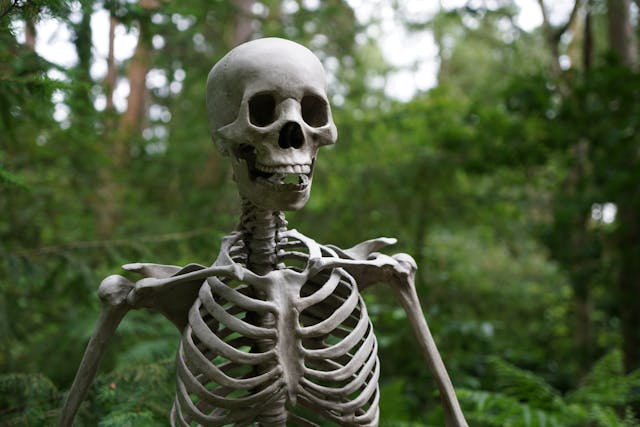
We see bones a lot around this time of year. Just walk down any street with kids livening in it and you might find at least one yard with a skeleton in it. They are a major symbol of Halloween, along with witches, bats, ghosts, and pumpkins. And you can spend as much money as you want putting a skeleton in your yard. We used to have cardboard cutouts of skeletons in school. The joints had little pins in them and you could “fold” the limbs up for storage. Nowadays you can plop down a few hundred dollars to get a giant size skeleton to put in your yard. I have even seen giant skeletons appearing to come up out of a hole in people’s roof.
Are skeletons scary? We all have one, right? So what is there to feel bad about seeing one? I think the frightening part of a skeleton is what those bones represent. It’s a bit like saying you are afraid of the dark. Most people that say this aren’t exactly afraid of darkness. Rather they are afraid of the uncertainty that darkness brings. “What is in that darkness?” we ask. It is the same thing with skeletons. “What happened to that person,” we ask. Something bad happened to someone. Imagine doing a home improvement project and you knock out a wall. When you peel back the drywall you discover a skeleton. Pretty scary stuff, because you start to wonder what happened. The skeleton represents death.
Ezekiel has the best story about skeletons. It happens in chapter 37. By this time Jerusalem has been besieged by Babylon and in fact has now fallen. Ezekiel is an exiled prophet. In chapter 37 God shows him a vision.
Ezekiel 37:1-14
37 The hand of the Lord was on me, and he brought me out by the Spirit of the Lord and set me in the middle of a valley; it was full of bones. 2 He led me back and forth among them, and I saw a great many bones on the floor of the valley, bones that were very dry. 3 He asked me, “Son of man, can these bones live?”
I said, “Sovereign Lord, you alone know.”
4 Then he said to me, “Prophesy to these bones and say to them, ‘Dry bones, hear the word of the Lord! 5 This is what the Sovereign Lord says to these bones: I will make breath[a] enter you, and you will come to life. 6 I will attach tendons to you and make flesh come upon you and cover you with skin; I will put breath in you, and you will come to life. Then you will know that I am the Lord.’”
7 So I prophesied as I was commanded. And as I was prophesying, there was a noise, a rattling sound, and the bones came together, bone to bone. 8 I looked, and tendons and flesh appeared on them and skin covered them, but there was no breath in them.
9 Then he said to me, “Prophesy to the breath; prophesy, son of man, and say to it, ‘This is what the Sovereign Lord says: Come, breath, from the four winds and breathe into these slain, that they may live.’” 10 So I prophesied as he commanded me, and breath entered them; they came to life and stood up on their feet—a vast army.
11 Then he said to me: “Son of man, these bones are the people of Israel. They say, ‘Our bones are dried up and our hope is gone; we are cut off.’ 12 Therefore prophesy and say to them: ‘This is what the Sovereign Lord says: My people, I am going to open your graves and bring you up from them; I will bring you back to the land of Israel. 13 Then you, my people, will know that I am the Lord, when I open your graves and bring you up from them. 14 I will put my Spirit in you and you will live, and I will settle you in your own land. Then you will know that I the Lord have spoken, and I have done it, declares the Lord.’”
What do bones signify in this story? It’s the same thing they signify in popular culture: death. And this death is magnified. The bones are “dry,” meaning life has left them long ago. And this happens in a valley too. It is very much like the valley of the shadow of death found in the Psalms. Life is gone. Israel’s spiritual state is dead. Hope is gone.
But it isn’t really. God breathes life into the bones, just as God breathed life into the first man in Genesis. God is doing the same thing to the nation of Israel that was done to Adam. It is a Halloween-like lesson that tells us hope is alive even if all else is lost. God is the only deliverer.
Skeletons are scary because of what might have happened to them.
This story is redeeming because of what God has done to them. Instead of being afraid because of what bad things may have happened, we are joyful because of what God has done.