
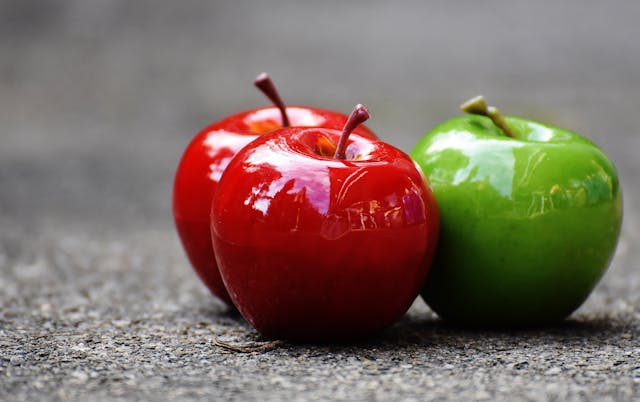
Have you ever heard of the phrase “apple of my eye?” I bet you have. But where did it come from? How did we start to associate an apple with someone’s eye? And what does that even mean? Well, according to Wikipedia, this term started out as a literal interpretation of the pupil, or the center of the eye. It was called the apple because apples were more or less round, and there weren’t a lot of spherical things to associate with.
The term later became to mean something or someone who was cherished above others. It’a a pretty old phrase, and was even in the King James Version of the Bible.
Psalm 17:8
Keep me as the apple of your eye;
hide me in the shadow of your wings
Deuteronomy 32:9-10
For the Lord’s portion is his people,
Jacob his allotted inheritance.
10
In a desert land he found him,
in a barren and howling waste.
He shielded him and cared for him;
he guarded him as the apple of his eye,
Apples are mentioned quite a lot in the Bible too. Here is one such place:
Proverbs 25:11
Like apples of gold in settings of silver
is a ruling rightly given.
And there are a whole lot more. But if I were to ask you what place in the Bible makes you think of apples the most what would you say?
You would say the Garden of Eden wouldn’t you? Be honest. If you haven’t read the story recently you might be surprised to learn that apples are not in that story at all. But I will come back to that in a bit.
There are more than 7500 cultivars of apples in the world. And we are making new ones all the time. As of a few years ago these were the top five most popular apples in America:
Gala
Red Delicious
Granny Smith
Fugi
Honeycrisp
The apple market is currently valued at about 103 billion dollars. And in the US the per capita consumption of apples was about 17.59 pounds in 2020. Apples are popular in America but are equally popular just about everywhere. They originated in Central Asia. North America just had crab apples until Europeans brought over other, more palatable kinds. And what about apple pie? Is that American? There certainly is a popular phrase here: “as American as apple pie.” But it turns out this isn’t really the case either. That phrase itself isn’t all that old, coming into its own during the Second World War. There are two apple pie recipes listed in the first American cookbook though. The dish started out in England, but we have adopted it as our own.
Apples are everywhere. But they aren’t as highly valued as they once were. That is most likely due to their being more sugar available now. If you put an apple in front of a group of kids alongside a cupcake or candy bar, you can make a great guess about which of those will be reached for. But back in biblical times there weren’t much sugary baked goods. People got their sweets from fruit (or honey). And apples were far more tempting. Maybe that’s why the story of Adam and Eve doesn’t relate to us as much as it could. “Just don’t eat the fruit,” we might say. “What’s the big deal? I could resist eating an apple.”
Here is why we associate apples with the forbidden fruit. Old French used the word “pom” to describe the tempting fruit in the story. The word “pom” originally meant “fruit.” But over time the meaning of “pom” changed to mean apple. So readers later would read the story in the Bible and think that apples specifically were meant to be the fruit of the tree of Knowledge, when that was never the original intent of the story.
The fruit that was not be eaten is the perfect symbol of temptation. But notice something interesting. The fruit wasn’t a temptation until they heard about what it could do for them. And indeed it is true that ignorance does defeat temptation. Anyone who has raised a child knows this. At first the baby-turned-toddler doesn’t care anything about sweets, because the little one doesn’t know any better. But once he or she has tasted his or her first sweet thing (for my kids it was soft serve ice cream), look out. Now they know what is out there. Now you as the parent have to ward them against sweet foods for the next decade or two.
So now that Eve knows about the fruit, the temptation begins. But why have this in the garden at all? Why would God introduce such a temptation to the first humans, essentially setting them up for failure? Wouldn’t it be kinder to just not have that tree there at all?
I don’t know, but I do have an opinion. You don’t learn anything from ignorance. Without temptation there is no possibility of overcoming it. And therefore there is no chance of growth. Overcoming temptation is tough, but the rewards can be great.
Temptation at is core (see what I did there?) is really about one thing: Can you put aside a short term gain in order to get a long term reward? Or do you choose the short term gain? If you are trying to lose weight, for example, the short term gain is the taste of the sweet thing you are craving. But the long term gain is a healthier you. The short term for Adam and Eve was the forbidden fruit. But the long term expense was dire.
How do you like them apples?